Tuesday, July 12, 2011

Gestalt Laws of Perceptual Organization

Gestalt is a German word that means "essence or shape of an entity's complete form," and the Gestalt Laws of Perceptual Organization are a set of laws that dictate (or speculate) how human beings perceive things.

The Law of Proximity:
Stimulus elements that are close to each other tend to be perceived as a group. For example,  in the image below, the circles that are close together are grouped together, resulting in four groups.
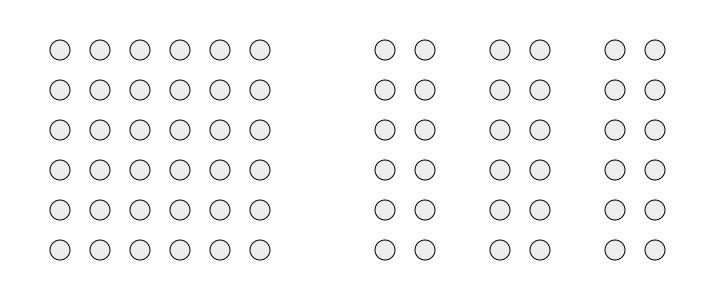
File:Gestalt proximity.svg

The Law of Similarity: 
Stimulus elements that are similar tend to be grouped together. For example, people tend to see the circles below as horizontal rows of black and white circles. 

The Law of Closure
Stimulus elements are grouped together if they seem to complete a "regular" figure. For example, we tend to think that there is a triangle in the image below, while in reality there isn't.

Law of Continuity:
Stimulus elements are grouped together to make the image look more "smooth." For example, in the following image you are probably going to see two straight lines instead of two V's.
Law of Symmetry:
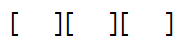
Stimuli tend to be grouped such that each group consists of a symmetric figure. For example, we see the following image as three pairs of closed brackets instead of six individual brackets.

Law of Simplicity
Stimuli are perceived in a way that makes them as simple as possible. For example, we tend to perceive the image below as six triangles rather than as some other combination of shapes.


Looking Back at Grade 11 Computer Science

Note: Even though this is a grade eleven course, I took it in grade ten.


Computer programming has always been something that I am good at and interested in, so I was very excited to be in this class at the very beginning of the school year. Indeed, I easily mastered the things that were taught in the class and I enjoyed doing the programming assignments. However, there were a lot of annoyances that made the experience in programming class a lot less enjoyable.

First was the marking scheme and how my teacher marked. She made the programming assignments so easy that a perfect or close-to-perfect mark was almost guaranteed for each of the assignments. As a result, even those who were not very good at programming got pretty high marks. And as everyone ended up getting very similar marks in the programming assignments, the reading assignment marks became the factor that decided whether your term mark was higher than the others. This placed me at a slight disadvantage because I wasn't very good at those assignments. Fortunately, I did better than most on the exam, so my final mark was still higher than them. However, I thought that the gap was a bit too small...

Yes I know that I  am sounding a bit arrogant, especially because I am referring to those who got 7-10% lower than me. However, judging by the questions that they asked me and how frequent they asked me those questions, it's pretty safe to say that they should have gotten a lot lower. Anyway, I will now set the issue of marks aside, as I believe that I have done enough ranting about marks already.

Monday, July 11, 2011

Major Sections of the Brain

Again, for the purpose of my own studying, I will type brief, point-form notes that are relevant to the topic.
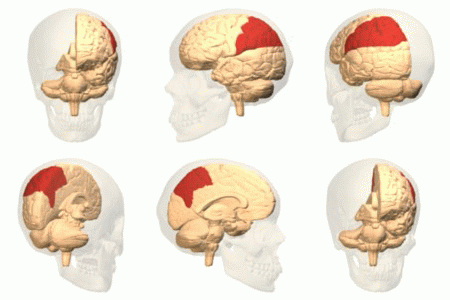
Frontal Lobe
- Allows reason and planning
- Initiates voluntary movements
- Modulates emotions and is involved in the making of personality
- Capable of turning thoughts into words
Parietal Lobe
- Allows sensory perception
- Takes in auditory and visual signals and associates them with memory
- Allows understanding of written and verbal language

Temporal Lobe
- Distinguishes volume and frequency
- Involved in forming and calling memory
- Right: visual memory; left: verbal memory
- Upper portion allows understanding of words
Occipital Lobe
- Decodes visual information
- Analyzes form, colour and movement
- Allows you to recognize and identify objects
NOTE: All images are from Wikipedia

Branches of Psychology


Since I have a psychology quiz tomorrow, I am going to briefly list the branches of psychology and give a very simple definition for each of them. Also, as a warning to anyone who might have come across this page accidentally via a search engine, the information on this page is probably all wrong because I doubt that my teacher actually understands what she teaches (and the definitions all came from her). So if you are looking at this page because of some assignment for school, do not use the information!

So here we go:
Behaviourism: The study of how humans react to the environment
Cognitive Psychology: The study of the mental processes that are involved in memory, learning and thinking
Structuralism: The study of how humans change their behaviours to adapt to changes in their surroundings
Humanism: The belief that human beings are capable of making choices, and that most behaviors are not determined by environmental factors or human drives.
Psychoanalysis: The process of a patient describing their feelings or experiences to a trained professional in the hopes of discovering unconscious thoughts that the patient has.
Functionalism: Observation of the inner-workings of human beings by conducting various experiments to see how humans experience perception and sensation.

Saturday, July 9, 2011

Blogger Header Image

This is the small version of the animation that I made

Today afternoon when I looked at my blog I suddenly felt that the top was a bit empty, so I decided to make a header image to fill the space.

However, the process wasn't nearly as easy as I have thought. Blogger did not have the options for us to change the image size or position, so I had to make tons of measurements before I could start making my image. Also, the actual image-drawing part was very tedious because I was trying to make an animated image that required lots of copy-and-pasting of the objects.

After about two hours, I finally finished the animation. But unfortunately, the final product was not suitable to be a blog header at all—it was too distracting. The animation contained so many movements that it made me feel dizzy, and I reasoned that it would probably do the same to the visitors. So even though I wasn't quite happy to abandon my work, I had to.

When I get more spare time, I will try to make another header image that is more simple and more suitable for  a blog. Meanwhile, I guess the blog will have to stay the same.

Friday, July 8, 2011

Importance of Marks

Speaking practically, marks prior to grade twelve are not important at all. They are almost never looked at when students apply for universities, and they definitely have no relevance at all when students progress even further into their lives and look for jobs or graduate opportunities.

Yet they are still important to many students, including me.

Even with the knowledge that currently all my marks will not affect my future, I still can't help feeling bad when receiving a bad mark. Even worse, it often takes me a long time before I can ward off these feelings. For example, in grade nine after I received a mediocre computer mark, I was so upset that I could not fall sleep at night, and had to go outside and take a walk before I could finally feel better. And today, after I saw my horrible summer school assignment mark, I felt so horrible that I could not concentrate for the rest of the afternoon.

This made me wonder, why do my marks have such an important place in my heart? Why do I care so much about my marks?

After much deliberation, I concluded that it must be because of the fact that marks are an indication of one's ability. Getting a poor mark even after spending a fair amount of effort basically means that your ability isn't great. This would be apparent to your peers and parents, and obviously it wouldn't be a good thing. But I think what's even worse is the fact that you would have to accept the truth about yourself— the fact that there are limits to your ability.

Wednesday, July 6, 2011

Looking Back at Grade 10 Science

The first thing that I could remember from science class was that it was boring. Almost everyday, the teacher would tell us to open our text books and ask for a volunteer to read a particular section of it. I often got so bored that I wanted to sleep. She would also do her power-point lessons, and those were even more soporific because during those lessons the lights would be out.

The second thing that I could remember from the class was that we did quite a lot of presentations. Actually, we only did two, but since usually there would only be one presentation in each class, two were considered to be a lot. And as usual, I did horrible in the presentations. Not just my usual horrible, by extremely horrible because I practised so little that it could well be said that I didn't practice at all. I mumbled through both of them, and I also skipped quite a lot of content because of my nervousness.

Now thinking back, I am actually glad that I have had these two presentations. These failures would always remain in my mind and they would always be served as a reminder of how bad I can perform in an oral presentation if I don't practice. They have actually motivated me to work hard on my subsequent presentations (even though I still did horrible on all of them).

I don't have much to say besides these two things. The course was generally easy, and my teacher was an easy marker. And besides the things that I learned in the optics unit, I would probably use everything that I have learned in this class in the future. Mitosis and the organ systems would be touched up in biology, and of course the basic things that we learned in the chemistry unit, such as balancing chemical equations, would be used in any future chemistry course(s).
---

Next up: Looking Back at Grade 10 Science
Go back to intro and a list of all posts in my grade ten reflection series