Showing posts with label economics. Show all posts

Tuesday, May 14, 2013

Foreign Exchange Market

 photo foreign_exchange_market.png

For simplicity, I will explain everything using the graph above.

In this case, The demand function is determined by the Japanese, who wants Canadian dollars in order to purchase Canadian goods, services, or assets.

The supply function is determined by Canadians, who want to exchange their currency for yen in order to purchase Japanese goods, services, or assets.

Things that increase the demand (the opposite decreases the demand) :
  • If Japanese people become richer, they will buy more imported goods, thus increasing demand for CAD.
  • If the interested rate of CAD rises, Japanese people will want to hold CAD as a financial asset
  • If inflation is higher in Japan than in Canada, Japanese people will want more imported goods because they become relatively cheaper
  • Speculation of a rise in CAD exchange rate.

Things that increase the supply (the opposite decreases the supply) :
  • Canadian investments in Japan
  • If Canadians become richer, they will buy more imported goods
  • Inflation in Canada

Sunday, May 12, 2013

Money Market


The horizontal axis should be labeled: quantity of money
The vertical axis should be labeled: nominal interest rate

The money supply is a vertical line.

Loanable Funds Market


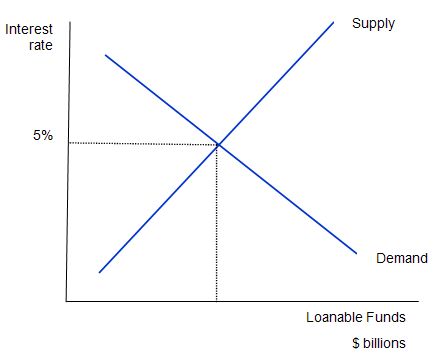
The lonanable funds market is our banks. The supply of loanable funds represents how much people are willing to deposit into their banks, and the demand represents how much people are willing to borrow.

The horizontal axis should be labeled: quanitity of loanable funds.
The vertical axis should be labeld: real interest rate (%).

Phillips Curve


The phillips curve is a curve showing the inverse relationship between unemployment rate and inflation rate. It represents the tradeoff between inflation and unemployment in the short run.

A rightward movement along the phillips curve represents a leftward movement of the AD curve, and vice versa.

An outward shift of the phillips curve represents a supply shock or an increase in inflationary expectation.

Wednesday, September 5, 2012

The Asbestos Problem

This was an assignment for my economics course

Asbestos is a mineral fiber that has many wonderful properties— it's fire-resistant, flexible, and a good thermal and acoustic insulator. With these useful qualities, it became extremely popular in the early 1900's, when people used it for a variety of things, such as wall insulation, roofing tar, and fire blankets.

Unfortunately, as wonderful as asbestos may seem, it is responsible for a multitude of diseases: it has been proven that exposure to airborne asbestos can cause lung cancer and mesothelioma (a cancer of the pleura of the lung), as well as asbestosis and diffuse pleural thickening. Cancer is almost always fatal, and the other two conditions result in the difficulty in breathing— which, if not fatal, severely affects the quality of life.

Thursday, July 12, 2012

Exclusive Interview With Adam Marx, on the Challenges Faced by University Graduates When Starting a Family

Note: This is my economic assignment, exactly as it was submitted onto the students works blog
Posted: Jun 14, 2012, by ___, New Life reporter

Nobel Prize winning economist Adam Marx is known for his studies about how different demographics make their economic decisions differently. In recent years, he has been focusing his studies on the challenges faced by the younger generation, especially university graduates.

Adam Marx speaks with New Life about the challenges that university graduates will face when they try to start a family. This is the first part of a series of exclusive interviews with economists to talk about the main challenges faced by different demographics.

To listen to the original interview, click here.

Wednesday, May 9, 2012

Monopolistic Competition

What is a monopolistic competition?
A monopolistic competition is an imperfect competition in which many firms sell a product that has product differentiation. An example would be the hamburger market, where there are many stores selling hamburgers, but the taste and quality of the burgers from each store are slightly different. The firms in a monopolistic competition are not price-takers, but they face a very elastic demand due to the availability of substitutes.

Also, there's an ease of entry and exit for a monopolistic competition

Advertising
In order to differentiate their products, firms in a monopolistic often rely on advertisements to create brand names, to increase market share.

In the short Run
In the short run, the graph of a firm in monopolistic competition is very similar to that of a monopoly. The marginal cost curve is different from the average revenue curve, the firm produces at a point where MR=MC, and it can earn economic profit by charging the consumers at where the quantity intersects with the demand curve..

The only difference is that the demand is more elastic, and therefore the demand and MC curves look more "flat".

Monday, May 7, 2012

Oligopoly

What is an oligopoly?
An oligopoly market is one that is dominated by a few large firms. Firms in an oligopoly selling similar but branded products, and thus advertising plays an important role in the market. Also, there are high barriers to entry, and thus the small number of firms in the market.

Interdependence of Oligopoly
Since there are only a few firms in the market, the decisions of one firm can significantly affect all the other firms. Thus, the firms are interdependent on each other, and in many cases they might want to collude.

Kinked Demand Theory (Non-collusive behavior)
If the firms do not collude, then for each individual firm, we will see a kinked demand curve. That is, at the current market price, the demand becomes elastic as price increases, and inelastic as price decreases.

Why? If a firm raises its price, then consumers are simply going to switch to the other firms. Thus, quantity will decrease drastically and the demand will be elastic. On the other hand, if a firm lowers its price, then all the other firms are going to follow suit. This, in the end, will mean that the firm doesn't get that much more quantity, and that the demand becomes sinelastic.

Monday, April 30, 2012

Monopoly

What is a monopoly?
Monopoly is a type of market where there is only one firm (monopolist) that supplies the good. The firm is very large, and has control of the market price (has a lot of market power).

Sources of Market Power
A monopoly has market power (the ability to set the prices higher than the marginal cost) because it has no competitors. Consumers have to either buy from the monopolist, or not have the good at all. As a result, there will be demand for the good even if the price is set high.

To maintain its market power, a monopolist has to avoid having competitions; once it has competitors, customers will no longer be willing to buy the highly-priced goods that it supplies. But how can it prevent competitors? High barriers to entry:
  • Economic barriers: economies of scale, superior technologies, and large initial investments are all things that benefit the existing firm, allowing it to produce more efficiently.
  • Legal barriers: patents and copy rights ensure that the monopolist is the only firm producing a good. Property rights may grant one firm the exclusive access to a certain resource.

Saturday, April 28, 2012

Theory of Consumer Choice

When dealing with consumers' choices, it is important to think about utility, which is a measure of satisfaction. The more utility a consumer has, the more satisfied they are with the goods or services that they have received.

Total Utility and Marginal Utility
These two terms are relatively straightforward. Total utility refers to the total amount of satisfaction that a consumer has gained from a certain amount of goods or services. On the other hand, marginal utility refers to the additional satisfaction that a consumer gets for the consumption of one extra unit of good.

Having a positive marginal utility means that the total utility is increasing, since marginal utility is the additional satisfaction. Similarly, having a negative marginal utility will result in a decrease in total utility.

Diminishing Marginal Utility
In most situations, we experience a diminishing marginal utility. That is, as we consume more and more of one good, our additional satisfaction from each unit of the good begins to be less and less. For example, if a person consumes one unit of a food that they like, they would be extremely satisfied from that unit of food. However, suppose they go on and consume 100 more units of the food, then one can imagine the person growing more and more tired of that food as they continue to consume it. Their marginal utility decreases.

However, it is important to note that even if marginal utility decreases, the total utility would still be increasing if MU is positive. It's just that the consumer is getting more satisfied at a slower rate.

Utility Maximization

Tuesday, April 24, 2012

Perfect Competition

What is a Perfect Competition?
A perfectly competitive market is a market that has many small firms and many individual buyers. Each seller has a very small share of the market, and as a result is a price taker; they cannot control the market price. Also, the products are all identical, and the consumers have perfect information about the market. That is, as soon as one firm prices its goods higher than its competitors, consumers will know and will switch to buying from other firms.

Additionally, there no barriers for entering or exiting the market, thus new competitors can arise at any moment, and companies can easily leave the market if they are losing profit.

Individual firm in the short run...
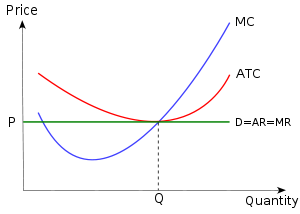
As mentioned above, each individual firm has such a small share of the market that it doesn't affect the market price at all. This means that whatever quantity it produces, it can always sell all of them at the market price, and the marginal revenue is constant. As marginal revenue is constant, the average revenue is also constant. So P=MR=AR.

A firm will always produce at a point where MR=MC. And since P=MR=AR, it will produce at a level where MC=P=MR=AR.

However, at this point, the price may be at, above, or below the average cost curve of the firm. If price is equal to average cost, then the company is making normal profit:

There is neither economic profit nor loss

Saturday, April 21, 2012

Consumer and Producer Surplus

Basic Definitions:
Consumer surplus: The difference between what consumers are willing to pay and what they actually pay.
Producer surplus: The difference between what the producers are willing to supply a good for and the actual price at which they sell the good.

In a graph:
In a graph, consumer surplus is represented by the area that is above the price, but below the demand curve.

On the other hand, producer surplus is represented by the area that is below the price, but above the supply curve.


Monday, April 16, 2012

Response to an Economics Question

Article: http://articles.latimes.com/2012/mar/24/business/la-fi-home-rental-20120324

For my economics assignment, we have to go in pairs and make presentations. For each presentation, the presenters have to summarize an article about an article on a current economic event, and pose two discussion questions .

Today, the presenters summarized the above article, and asked: "Do you think this pilot program will be successful? Will homeowners and investors be interested?"

My Response
In my opinion, this program will be successful, as it will definitely attract both homeowners and investors.

Sunday, April 15, 2012

Preparing for AP Microeconomics Exam

For my AP economics class, I have go to an afternoon session every Tuesday to learn the AP material and prepare for the AP exam. 

However, for the past few weeks, I have been feeling that these afternoon sessions really aren't enough of a preparation for the exam. This is partly because the lessons are all taught by other students (so sometimes they don't know the materials themselves), and partly because each session is only 1 hour to 1.5 hours long.

Anyway, regardless of why the afternoon sessions are not effective, I will have to do quite a lot of studying on my own. So just a while ago, I have placed hold on several AP microeconomics books, and I am planning to go through all of them once they have arrived. In addition, I am planning on making a blog post on each of the topics that may be covered in the exam. These include:
  • Consumer and Producer Surplus
  • Income and Cross-price elasticity
  • Perfect competition
  • Monopoly
  • Monopolistic competition
  • Oligopoly 
  • Collusion
  • Game theory
  • Factor markets
  • Market failures

That's 10 topics that I have to cover in four weeks (the AP exam isn't actually that far away)! I must thoroughly study six for the next two weeks, and then the other four during the remaining two weeks. Ugh, such a busy studying schedule, considering that this is something "extra."

Wednesday, March 7, 2012

Income and Cross-Price Elasticities of Demand

In regular economics class, we have learned that buyers’ incomes and prices of other goods are both demand determinants that shift the demand curve. Now, income elasticity and cross-price elasticity are measures that tell us “how much” the demand is shifted. In other words, income elasticity of demand gives us information about how responsive the demand (for a good) is to a change in income . Cross-price elasticity tells us how responsive the demand (for a good) is to a change in the price of another good.

Income Elasticity:
  • Definition: the measure of how much the demand for one good responds to a change in consumers’ income.
  • How to calculate: see “formulas”
  • Other important information:
    • A good is inferior if it has a negative income elasticity
    • A good is normal if it has a positive income elasticity
    • The greater the absolute value of the income elasticity, the more income-elastic the good is (the more the demand is affected by the income)
    • If income elasticity is between zero and one, the good is income-inelastic, and can be classified as a normal necessity
    • If income elasticity >1, the good is income- elastic, and can be classified as a luxury good.