Sunday, April 15, 2012

Looking Back At Grade 11 English

Ha, semester one has been over for more than two months, and I still haven't written my personal reflections for English and physics. Such a procrastinator...

Anyway, grade 11 English was probably the most stressful course that I have had in my school career (so far). For one, its workload was a lot heavier than those of the other courses. For example, I remember that during December, we had this many things due:
  • Speech 
  • Macbeth culminating activity (mine was a story book)
  • ISP essay

This may not seem like too much, but considering that the Christmas holidays started on December 16th, and the fact that these three big assessments were all due before the holidays, I really think that the schedule was a bit cramped.  

Preparing for AP Microeconomics Exam

For my AP economics class, I have go to an afternoon session every Tuesday to learn the AP material and prepare for the AP exam. 

However, for the past few weeks, I have been feeling that these afternoon sessions really aren't enough of a preparation for the exam. This is partly because the lessons are all taught by other students (so sometimes they don't know the materials themselves), and partly because each session is only 1 hour to 1.5 hours long.

Anyway, regardless of why the afternoon sessions are not effective, I will have to do quite a lot of studying on my own. So just a while ago, I have placed hold on several AP microeconomics books, and I am planning to go through all of them once they have arrived. In addition, I am planning on making a blog post on each of the topics that may be covered in the exam. These include:
  • Consumer and Producer Surplus
  • Income and Cross-price elasticity
  • Perfect competition
  • Monopoly
  • Monopolistic competition
  • Oligopoly 
  • Collusion
  • Game theory
  • Factor markets
  • Market failures

That's 10 topics that I have to cover in four weeks (the AP exam isn't actually that far away)! I must thoroughly study six for the next two weeks, and then the other four during the remaining two weeks. Ugh, such a busy studying schedule, considering that this is something "extra."

Wednesday, April 11, 2012

Early Ideas/Beliefs About Heredity

Hippocrates:
Greek philosopher Hippocrates believed that every part of the parents produced "seeds," which would fuse together to create the offspring

Aristotle:
Aristotle believed that male and female semen mixed upon conception.

George Harvey
English physician George Harvey theorized that individuals arose through the process of epigenesis; he believed that embryos formed in stages and that their development could be affected by factors inside and outside of the mother.  

Anton van Leeuwenhoek
This dutch scientist, who invented the microscope, believed that each sperm contained preformed embryos and that the development of the offspring was controlled by the male parent. On the other hand, mothers had almost no effect on the offspring, except providing an environment for the embroys to develop.

Charles Darwin
Charles Darwin believed that the offspring contained variations of traits from both parents. However, he couldn't explain why.

Pangenesis
The belief that each organ contains "genes," which travel through blood, the parents' genitals, and into the children.

Blending Traits:
The belief that offsprings are the "mix" of the parents. (e,g, red flowers and blue flowers would produce purple flowers)

Monday, April 9, 2012

Factoring Polynomials

A Review Of Some Concepts (for myself):
Remainder Theorem:
When dividing a polynomial expression p(x) by a linear polynomial expression x-b, the remainder is p(b).

Factor Theorem:
A linear expression x-b is only a factor of p(x) if p(b) is 0. (So there must not be any remainder)

Integral Zero Theorem:
If x=b is an integral zero of the polynomial P(x), then the constant term of P(x) must be divisible by 2.

Rational Zero Theorem:
If x=b/a is a rational zero of the polynomial P(x), then the constant term of P(x) must be divisible by b, and the leading coefficient must be divisible by a.

Sunday, April 8, 2012

Becoming A Christian??

For the past few weeks, I have become quite involved with church activities.

I have been going to my ethnic United Church youth group for four weeks, and just this week, I went to the bible study session at my friend's church.

During these occasions, I have learnt quite a lot of basic information about Christianity. For example, I learned the differences between the Old Testament and the New Testament, I learned the stories in Exodus and Genesis, and I learned several teachings/principles of the religion.

So do I believe in god yet? Of course not. I have grown up in a family that doesn't have a religion, and the majority of the people around me were either atheists or agnostics. Therefore, I have never really thought about God's existence or non-existence, and have never imagined that there would be a superior being watching over me.

But will I ever become a believer? I don't know. I want to be a Christian— I really agree with many of their beliefs, and admire their virtues— but at this stage, it's still hard for me to just accept the existence of God as a fact. And I simply can't imagine how I may change my beliefs over time. So basically, there's no way to tell.

Meanwhile, I should try my best to attend youth groups and bible studies, to expand my knowledge on the bible and Christianity. And hopefully within a few months, I will begin to have a better understanding of my own beliefs.
---
If you find this post to messy and confusing, it simply reflects my state of mind. I am really confused about what my beliefs, and what they will be.

Saturday, April 7, 2012

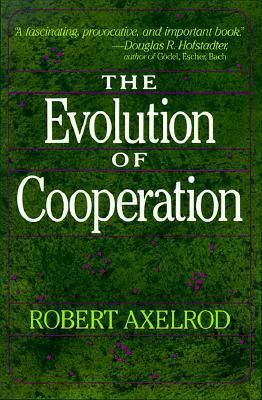
The Evolution of Cooperation by Robert Axelrod

image taken from here
In The Evolution of Cooperation, Robert Axelrod studies the evolution and nature of cooperation through his two computer tournaments of prisoner's dilemma. In both of his tournaments, the winning program employs the tit for tat strategy, and he attributes the success to:
  • Being nice: it always cooperates unless the opponent defects
  • Provocable: one provoked (being defected), it is quick to defect on the next turn. Thus it is not exploitable.
  • Forgiving: it forgives the opponent for defecting as soon as the opponent switches to cooperating. This makes it easy for the two sides to restore to mutual cooperation
  • Clarity: its strategy is very clear, allowing the opponent to know that it is best to cooperate with it
In the book, the author also discusses how this might come in play in many situations, the "stability" of such a strategy, as well as how to encourage or discourage cooperation.

My Sister's Keeper by Jodi Picoult


In My Sister's Keeper by Jodi Pocuolt, 13-year-old Anna Fitzgerald was born with the intent that her cord blood would cure her sister, Kate, of Leukemia. However, Kate started relapsing five years after Anna's birth, requiring Anna to donate her blood, bone marrow, and— finally— kidney. This prompts her to sue her parents so that she can get medical emancipation from them.

From this, it is quite clear that the book centers on the issue of organ transplantation. It raises many questions regarding the ethics of organ transplantation, and lets the readers to deliberate over them. For example, should parents be able to genetically screen the embryos of their children, to ensure that the children can become matching donors for their older siblings?

What amazed me, though, was how the author managed to show the dynamics and complexity of Anna's household. By including narrations from each of the family members (except Kate), Picoult successfully illustrated the complicated relationships between each pair of family members and the conflicting emotions of them. To me, this was great because it demonstrated the extent to which a family could be affected by the issue; it showed the human and emotional— as opposed to the legal —side of the story.

In my opinion, though, the book had some flaws. For one, I found it entirely unnecessary to include Julia's and Campbell's (the lawyer's) relationship— I just don't see how it's relevant! Also, I quite disliked the ways in which Anna interacted with Campbell. She was always extremely rude and disrespectful, which didn't seem to match her personality depicted throughout the other parts of the novel.

Overall, I definitely think that this is a novel that is worth reading. It has a unique theme, as well as a good storyline. There were some parts that I didn't like, but for the most part it was good and thought-provocative.