Sunday, May 12, 2013

Money Market


The horizontal axis should be labeled: quantity of money
The vertical axis should be labeled: nominal interest rate

The money supply is a vertical line.

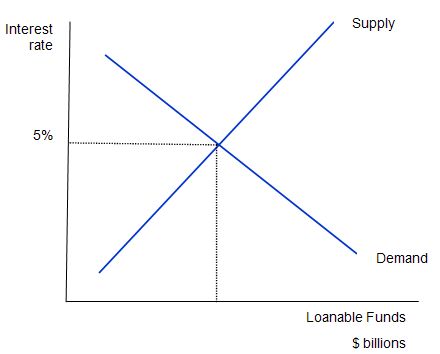
Loanable Funds Market


The lonanable funds market is our banks. The supply of loanable funds represents how much people are willing to deposit into their banks, and the demand represents how much people are willing to borrow.

The horizontal axis should be labeled: quanitity of loanable funds.
The vertical axis should be labeld: real interest rate (%).

Phillips Curve


The phillips curve is a curve showing the inverse relationship between unemployment rate and inflation rate. It represents the tradeoff between inflation and unemployment in the short run.

A rightward movement along the phillips curve represents a leftward movement of the AD curve, and vice versa.

An outward shift of the phillips curve represents a supply shock or an increase in inflationary expectation.

Sunday, April 28, 2013

Anxiety

On Monday or Tuesday, I received a letter from McMaster University, which indicated that I should be expecting my acceptance/rejection letter for their Health Sciences program at the beginning of May. 

This week was also the week that my midterm marks were sent to OUAC, which further reminded me of universities in general.

Sunday, March 24, 2013

DNA Replication-- Summary

The following are the summary of what happens during DNA replication:

  1. Starting from the origin of replication (ori), helicase unwinds the the double helix. Single-stranded bonding proteins (SSBPs) bind to the single stranded DNA to keep them apart.
  2. RNA polymerase constructs RNA primers on both leading and lagging strands
    • The leading strand is continuously elongated by DNAP III.
    • The lagging strand is elongated discontinuously. Each okazaki segment is primed with RNAP, and then elongated by by DNAP III. DNAP I replaces the RNA primer with DNA, and DNA ligase joins the fragments together by catalyzing the formation of phosphodiester bonds.
  3. This process continues until the replication fork meets the replication fork of another replication bubble, or when the end of the DNA strand is reached.

Sunday, December 30, 2012

Waves Basics

Basics
  • A wave is a disturbance in a medium that carries energy.
  • Two points are in phase if they have the same motion at all times
  • Two points are completely out of phase if their motions are always opposite
  • Superwaves are created when two identical waves move toward each other

Path Length and Path difference
  • Path length: the distance from a point to the source of a wave
  • Path difference(Δ): the difference between the path lengths of two different waves
  • If two point sources vibrate in phase with each other, they would be in-phase at points where Δ is a whole number multiple of λ
Waves at Boundaries
  • The frequency of a wave never changes
  • Snell's law: n×sin(θ) is constant (n is the index of refraction)
  • If a wave travels from a faster medium to a slower medium, the transmitted wave becomes inverted

Interference from two point-sources
  • If a point P is very far away from the two sources, then Δ= d×sin(θ), where d is the separation between the sources, and θ is the angle between the perpendicular bisector of the sources and the line joining P and the midpoint of the two sources


Young's double slit experiment:
  • Problem: to have two point sources of light that are coherent
  • The first slit acted as a point source of light
  • The double slit acted as two point sources of light
  • On the screen, the bright fringes are where the antinodal lines are
  • The dark fringes are where the nodal lines are

Interference of thin films:
  • Use the theory of "waves at boundaries" and path difference to do these problems
  • n1×λ1=n2×λ2


Thursday, December 20, 2012

A Busy Winter Break

There are actually a lot of things that I need to do during this winter break. This means that I cannot just waste days playing games and doing nothing; I cannot afford to waste the valuable time.

So I decided to make this post to remind myself of all the things that I need to do:

University Applications:
  • Engineering essay (600 words)
  • Engineering extracurricular activities
  • Engineering academic achievements
  • What is a folly act?
  • What defines you as you?
  • What is an educated person?
  • Write a reference letter for yourself

School
  • Study for physics
  • Study for calculus
  • Prepare for physics presentation
  • Work on philosophy essay