Wednesday, May 2, 2012

Digestive Tract #1

The digestive tract (also called the alimentary canal or the gastrointestineal tract) consists of: mouth→ pharynx→ epiglottis→ esophagus→ stomach→ small intestine→ large intestine→ anus

This entire post will be used to describe each part of the digestive tract, as well as other organs in the digestive system, such as livers and gallbladders.

Mouth:
The mouth (oral cavity) is where the food enters our body, and in it, both physical and chemical digestion take place.

The teeth physically break down the food, with different types of teeth breaking the food down different ways:
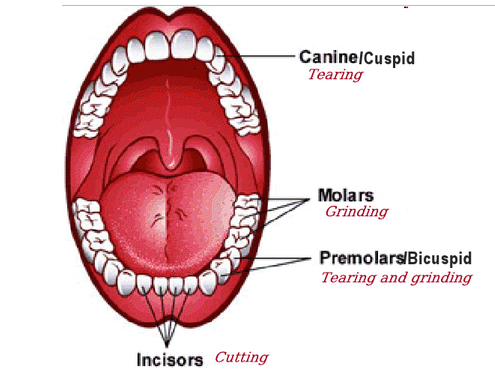

The saliva contains mucus and enzymes, such as amylase (breaks down polysaccharides) and maltase. Saliva is produced by the salivary glands, which are the parotid gland, the sublingual gland, and the submandibular gland:


The tongue moves the food when the person is chewing. In addition, it has taste buds, which are receptors that send messages to our brain: 


In the mouth, with the chewing and the mixing with the saliva, the food becomes a food bolus, and it now travels to the pharynx.

Esophagus: 
The food bolus then goes through the pharynx and into the esophagus, and long muscular tube made up circular and longitudinal muscles. In the esophagus, food is moved along with peristalsis.

Stomach:
At the end of the esophagus, there's the cardiac sphincter, which controls the movement of the food from the esophagus to the stomach. The stomach is a J-shaped organ with a volume of 1.5L, and it has thick layers of smooth muscle (rugae) that allows it to stretch. The stomach uses its longitudinal, circular, and oblique muscles to churn the food, and it also secretes gastric juices to chemically digest the food.

With both physical and chemical digestion, the food bolus is turned into a thick liquid called chyme.

Some components of the gastric juice:
  • Hydrochloric acid: destroys invading microbes, breaks down food bolus, and turns pepsinogen into pepsin
  • Pepsinogen: In acidic environments, it turns into pepsin, which breaks polypeptides into dipeptides
  • Lipases: enzymes that break down lipids
  • Mucus: secreted by the rugae, it forms a protective coating for the stomach that prevents the hydrochloric acid from burning through

Monday, April 30, 2012

Monopoly

What is a monopoly?
Monopoly is a type of market where there is only one firm (monopolist) that supplies the good. The firm is very large, and has control of the market price (has a lot of market power).

Sources of Market Power
A monopoly has market power (the ability to set the prices higher than the marginal cost) because it has no competitors. Consumers have to either buy from the monopolist, or not have the good at all. As a result, there will be demand for the good even if the price is set high.

To maintain its market power, a monopolist has to avoid having competitions; once it has competitors, customers will no longer be willing to buy the highly-priced goods that it supplies. But how can it prevent competitors? High barriers to entry:
  • Economic barriers: economies of scale, superior technologies, and large initial investments are all things that benefit the existing firm, allowing it to produce more efficiently.
  • Legal barriers: patents and copy rights ensure that the monopolist is the only firm producing a good. Property rights may grant one firm the exclusive access to a certain resource.

Essential Nutrients

Nutrients are chemicals that an organism needs to carry out its life processes.

Out of all the nutrients, many of them need be obtained from our diet. This may be because our bodies do not synthesize enough of these nutrients, or because our bodies do not synthesize thems at all. We call these nutrients essential nutrients, and categorize them into the following: carbohydrates, fats, proteins, minerals, vitamins, and water.

Saturday, April 28, 2012

Theory of Consumer Choice

When dealing with consumers' choices, it is important to think about utility, which is a measure of satisfaction. The more utility a consumer has, the more satisfied they are with the goods or services that they have received.

Total Utility and Marginal Utility
These two terms are relatively straightforward. Total utility refers to the total amount of satisfaction that a consumer has gained from a certain amount of goods or services. On the other hand, marginal utility refers to the additional satisfaction that a consumer gets for the consumption of one extra unit of good.

Having a positive marginal utility means that the total utility is increasing, since marginal utility is the additional satisfaction. Similarly, having a negative marginal utility will result in a decrease in total utility.

Diminishing Marginal Utility
In most situations, we experience a diminishing marginal utility. That is, as we consume more and more of one good, our additional satisfaction from each unit of the good begins to be less and less. For example, if a person consumes one unit of a food that they like, they would be extremely satisfied from that unit of food. However, suppose they go on and consume 100 more units of the food, then one can imagine the person growing more and more tired of that food as they continue to consume it. Their marginal utility decreases.

However, it is important to note that even if marginal utility decreases, the total utility would still be increasing if MU is positive. It's just that the consumer is getting more satisfied at a slower rate.

Utility Maximization

Tuesday, April 24, 2012

Perfect Competition

What is a Perfect Competition?
A perfectly competitive market is a market that has many small firms and many individual buyers. Each seller has a very small share of the market, and as a result is a price taker; they cannot control the market price. Also, the products are all identical, and the consumers have perfect information about the market. That is, as soon as one firm prices its goods higher than its competitors, consumers will know and will switch to buying from other firms.

Additionally, there no barriers for entering or exiting the market, thus new competitors can arise at any moment, and companies can easily leave the market if they are losing profit.

Individual firm in the short run...
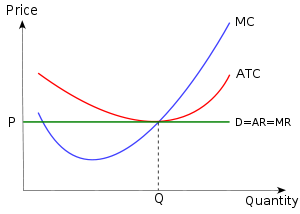
As mentioned above, each individual firm has such a small share of the market that it doesn't affect the market price at all. This means that whatever quantity it produces, it can always sell all of them at the market price, and the marginal revenue is constant. As marginal revenue is constant, the average revenue is also constant. So P=MR=AR.

A firm will always produce at a point where MR=MC. And since P=MR=AR, it will produce at a level where MC=P=MR=AR.

However, at this point, the price may be at, above, or below the average cost curve of the firm. If price is equal to average cost, then the company is making normal profit:

There is neither economic profit nor loss

Saturday, April 21, 2012

Consumer and Producer Surplus

Basic Definitions:
Consumer surplus: The difference between what consumers are willing to pay and what they actually pay.
Producer surplus: The difference between what the producers are willing to supply a good for and the actual price at which they sell the good.

In a graph:
In a graph, consumer surplus is represented by the area that is above the price, but below the demand curve.

On the other hand, producer surplus is represented by the area that is below the price, but above the supply curve.


Monday, April 16, 2012

Response to an Economics Question

Article: http://articles.latimes.com/2012/mar/24/business/la-fi-home-rental-20120324

For my economics assignment, we have to go in pairs and make presentations. For each presentation, the presenters have to summarize an article about an article on a current economic event, and pose two discussion questions .

Today, the presenters summarized the above article, and asked: "Do you think this pilot program will be successful? Will homeowners and investors be interested?"

My Response
In my opinion, this program will be successful, as it will definitely attract both homeowners and investors.