Friday, April 29, 2011

Boiling Grapes in Water— A Fine Recipe

A few days ago I found that the grapes in the fridge were almost rotten, and they did not taste very well. Since throwing these grapes out would be too wasteful, I decided to try something new with them— to boil them in water.

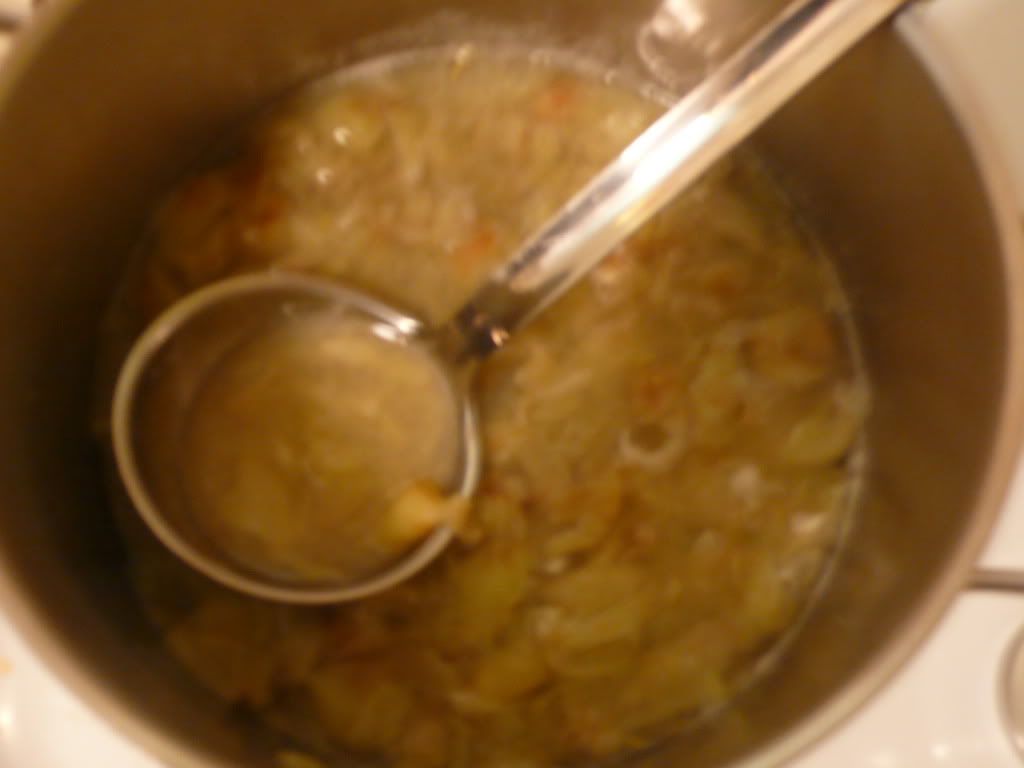
I put all of the grapes into a cooking pot, and added enough water so that the surface of the water would cover all the grapes. Then, I heated the pot until the water started to boil. At that point, I started using my spoon to squash all the grapes, and then I continued to heat the pot until the grapes could not decompose any further (or about 1 hour after). At the end the mixture looked like this:

The solid things that you see are the peels/skins

And another picture...


The thick mixture tasted very sweet (in a good way), and the grape peels had very good texture.The things you saw in the pictures were ready to serve! Of course you could cool it or even freeze it (I actually think it tastes best when frozen), or add a bit water to make it less concentrated.

Does it look better in a cup?

Overall, I think this went rather successful—the product was wonderful! Next time if your grapes are almost rotten, you may want to consider doing this too. :)


Lucky!

Today I had a chemistry test on stoichiometry, and we got 75 minutes to do five multiple choice questions, five true or false questions, and eight calculation questions.

Out of the calculation questions, question five was was supposed to be the hardest. It was a question that we had never discussed in class before and it involved quited many steps. As a result, I could not think of a way to solve this problem right away when I read the question.

As a habit, I always leave the hardest questions to the end and do the easier ones first, and this time was no exception. After thinking about the question for fifteen to twenty seconds and having absolutely no idea how to solve it, I decided to try questions six, seven and eight first.

Question six was easy. All that was required was to balance a chemical reaction and find the molar ratios between some compounds. This question was somewhat similar to the ones that we have done in class before, and I started doing the calculations as soon as I finished reading the question. As the question was not complex, I was soon moving onto part c). 

This was when my teacher spoke. He told us to change one of the values in question five, which basically meant that the people who had already finished doing the question would have to go back and change their answers. "Hehe," I laughed in my heart when I saw some other students fiercely turning their test papers and rubbing their erasers against the poor sheets of paper. "Lucky that I am not one of them," I thought. Then, my happiness level increased even more when I heard some people moaning about the change.

About five minutes later, when I was working on question seven, my teacher spoke again—he told us that question five would be disregarded because somehow he messed the numbers up. We would not need to do the question, and the question would basically be taken out of the test. This time the moaning became even louder because this meant that the people who had attempted at the question had just wasted their time, and some students even began to protest.

Thursday, April 28, 2011

Stoichiometry Note #2: Converting Moles to Molecules

Previous: The Mole and the Avogadro Constant                                   Next Molar Mass


The above formula is the formula for converting the number of moles into the number of molecules.

Variables:
  • N: Number of molecules
  • n: Number of moles
  • NA :The Avogadro constant 

Explanation: 
This should be quite straight-forward. We know that the Avogadro constant is  6.22×10²³, meaning that there are 6.22×10²³ molecules for every mole present, and therefore we multiply the Avogadro constant by the number of mols to obtain the number of molecules. This is the same as dozens. If one dozen equals to twelve, then three dozens equal to 3*12, which is 36. 

You can also use this equation to convert the number of molecules to the number of moles. You just change the equation a bit:


Other Important Information
One thing that you need to keep in mind is that the variable n is the number of molecules, which is different from the number of atoms. For example, say you have 10 molecules of H2O, you will actually have 20 atoms of hydrogen because for every molecule of H2O, you'll have two hydrogen atoms (look at the subscript!)


Examples:
A) How many atoms of magnesium are in 0.76 mol of a magnesium sample?
B) If there are  3.11×1024 molecules of gold in a sample of a metal, how many mols of gold are present in the sample?
C) How many atoms of potassium are in 0.880 mol of  K2O?
.
.
.
Answers:

Another Way of Studying?

I have decided to try another way of studying. Instead of simply reviewing my notes and reading the text book, I would try to organize whatever I know into "lessons" -- basically I would make blog posts that would teach the material to other students. Actually, these posts/texts should should be called "notes" because I do not think that they will be good or clear enough for people to actually learn the concepts.

This would serve as a great opportunity for me to fully understand all the materials. By trying to communicate the ideas, I would really have to think over them and would in turn have better understandings of them. Doing so will also help me remember the materials, and perhaps my writing/communication skills will improve.

I hope that this method of studying will actually work for me and I also hope that I will be able to keep this up for a long time.
---

My first one is done!
Chemistry Note #1: The Mole and the Avogadro's Constant

Stoichiometry Note #1: The Mole and the Avogadro Constant

Next: Converting Moles to Molecules


There are tons of different units that we use to measure quantity, and they all allow us to communicate more easily when talking about certain things. For example, a dozen eggs means twelve eggs, and it will be much easier to say "twelve dozen eggs" than to say "one hundred and forty-four eggs." In short, by using these units, we can often make numbers a lot more simple.

One unit that is often used in chemistry is the mole. It is very much like the quantities"dozen" and "pair," in the way that it also refers a specific number. However, it refers to a seemingly strange and unusually huge number— 6.0221479×10²³ .

This number is called the Avogadro constant, and has a symbol of NA. 

So how is the Avogadro constant determined? It is very simple—it is the number of molecules in exactly twelve grams of carbon-12 and it is obtained by conducting experiments. This means that as time progresses and our technology improves, we may be able to measure this number more accurately and the accept value for the Avogadro constant may continue to change over the years. 

Also, to avoid confusion, even though the value for mole is obtained by counting the number of molecules in 12 grams of carbon-12, the mole is a unit or a quantity that can be used for all types of molecules. For example, one mole of H2O will contain 6.0221479×10²³  molecules of H2O and one mole of silver will also contain  6.0221479×10²³ silver atoms.
---

Wednesday, April 27, 2011

Rules

Rules influence people's behaviors in ways that allow our society to function. Without them, there will be no order in the world, and the world is going to turn into a complete chaos.

So why are rules effective in altering or influencing people's behaviors? I think this is quite obvious--people follow rules to avoid the bad consequences. In other words, the negative consequences serve as a disincentive for breaking the rules. For example, the possibility of getting fired precludes workers from not arriving at work on time, and potential imprisonment stop people from stealing items. 

However, what if a rule had no consequences for breaking it? Would it still be effective? I do not think so. For example, if there were no penalties for using hands while playing soccer, all players would naturally want to use their hands as it would be much easier to score that way. In fact, they would have to use their hands as it would be the only way to defeat the other team. This means that rules would equate to nothing if there were no negative consequences for breaking them.
---
Finally, I am getting to my point. As something similar to rules, due dates would also only be effective if there were consequences for not meeting them. In school, the most common consequence is getting a few percentages off of the final mark, and to me this is a reasonable and essential penalty because this makes it fair  for people who have handed their work on time and this is the only way to ensure that most students do not hand things in late.

Unfortunately, my career class happens to be a class where the due dates do not seem to be significant. Today we were supposed to be handing in our career wheels, but many people had not even start on theirs and the teacher extended it to tomorrow, with no penalty at all. What upset me was not the fact that they could hand the assignments in tomorrow, but the fact that the teacher did not seem to care at all and seemed to be ready to give out one-month extensions without penalties.

I wanted to ask him, "what's the point of having these due dates?"

Tuesday, April 26, 2011

Getting Back On Track

In a post in February, I talked about how I was going to study for vocabularies. I actually did, and in less than two months I have finished 900 words on the word list. However, for almost two weeks now, I haven't studied any new vocabulary and neither have I reviewed the old vocabularies.

I originally took a break from studying vocabularies because I needed to memorize my history speech, and I thought it was important that I did not divert my concentration. However, somehow the history speech kept getting postponed and my break just kept extending.

When I finally did my history presentation on last Thursday, the long weekend approached and technically I should have had a lot of time during the long weekend to at least review the vocabularies. Unfortunately, I wasted a lot of time on watching cartoons and playing games, and I just kept forgetting about studying the vocabularies.

I am afraid that if I don't take any action now, I may never go onto the word lists again, so I am determined to resume my vocabulary-studying... starting tomorrow. Tomorrow morning in the subway I shall look at the vocabularies from the past and try to review them. At night I shall test myself on these vocabularies, and hopefully the results will not be horrible.