Showing posts with label physics. Show all posts

Sunday, December 30, 2012

Waves Basics

Basics
  • A wave is a disturbance in a medium that carries energy.
  • Two points are in phase if they have the same motion at all times
  • Two points are completely out of phase if their motions are always opposite
  • Superwaves are created when two identical waves move toward each other

Path Length and Path difference
  • Path length: the distance from a point to the source of a wave
  • Path difference(Δ): the difference between the path lengths of two different waves
  • If two point sources vibrate in phase with each other, they would be in-phase at points where Δ is a whole number multiple of λ
Waves at Boundaries
  • The frequency of a wave never changes
  • Snell's law: n×sin(θ) is constant (n is the index of refraction)
  • If a wave travels from a faster medium to a slower medium, the transmitted wave becomes inverted

Interference from two point-sources
  • If a point P is very far away from the two sources, then Δ= d×sin(θ), where d is the separation between the sources, and θ is the angle between the perpendicular bisector of the sources and the line joining P and the midpoint of the two sources


Young's double slit experiment:
  • Problem: to have two point sources of light that are coherent
  • The first slit acted as a point source of light
  • The double slit acted as two point sources of light
  • On the screen, the bright fringes are where the antinodal lines are
  • The dark fringes are where the nodal lines are

Interference of thin films:
  • Use the theory of "waves at boundaries" and path difference to do these problems
  • n1×λ1=n2×λ2


Tuesday, January 24, 2012

Forces and Motion #1: The Basics

Basic Terms:

Kinematics: The analysis of the motion of an object without considering the forces acting on it
Dynamics: The study of the motion of an object with considerations of the object's mass and the forces acting on it
Mechanics: The study of the motions with considerations of both kinematics and dynamics.

Scalar Quantity: Any quantity that can be defined by a single number and a unit of measure (e.g., mass, distance, speed)
Vector Quantity: Any quantity that must be defined by using a number, a unit of measure, and a direction (e.g., velocity, which you have to specify the direction).
Position: The location of an object with respect to the reference point. It's a vector quantity.

Saturday, January 21, 2012

Magnetism: Right Hand Rule #4

Brief History
  • In 1820, Ampere showed that a constant current could produce a constant magnetic field
  • In 1832, Michael Faraday tried to prove that a constant magnetic field could produce a constant current. However, during his experiment, he found out that it was only when the magnetic filed was changing that current was produced. This was how alternating current (AC) was discovered.
General effect
Moving a magnet toward a copper ring will induce a current in the copper ring. However, once the movement is stopped, the current will disappear

Right Hand Rule #4
(Unfortunately, I do not have enough time to make a picture)
With an open palm:
  • Thumb points toward the relative motion of the copper ring or coil (the magnet is the reference point).
  • Fingers point toward the direction of the magnetic field has it crosses the copper ring
  • Out of the palm is the direction of the current
Lenz's Law
Using the law of energy conservation, Heinrich Lenz showed that the induced current produced would always produce a magnetic field that would oppose the motion of the coil. So for example, if the north pole of a magnet approaches a coil, this is what would happen:


Magnetism: Right Hand Rule #3

Background information
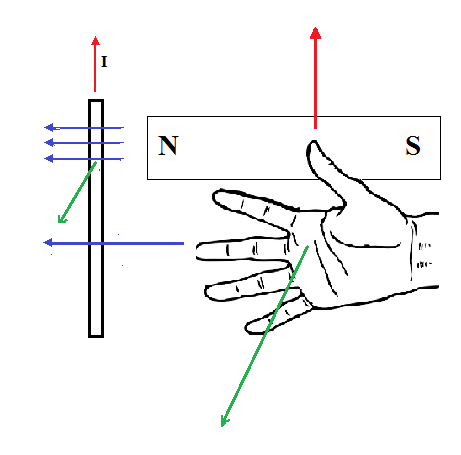
If a current-carrying conductor is placed perpendicular to the magnetic field of a magnet, there will be a force acting on the conductor.


Right Hand Rule #3
Red arrows (direction of thumb) represent the direction of current.
Blue arrows (fingers) represent the direction of the magnetic field from the bar magnet.
Green arrows (direction of palm) represent the direction of force acting on the conductor.


Parallel conductors
When two current-carrying conductors are parallel to each other, they would either attract or repel each other. If the two currents are in the same direction, the two conductors will attract; if the two currents are in opposite directions, the two conductors will repel.


Motor Force
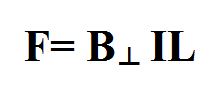
The force that a magnet exerts on a current-carrying conductor can be found using the following equation:
B is the strength of the magnetic field that is perpendicular to the current
I is the current in amperes
L is the length of the conductor (calculated by number of coils multiplied by the length of each coil)

Magnetism: Right Hand Rule #2

Term(s):
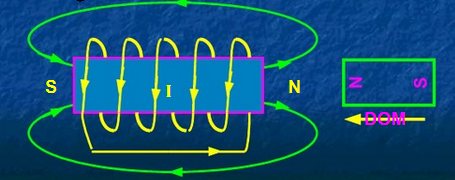
Solenoid: a coil wound into a tightly packed helix (usually made of copper).
Electromagnet: a type of magnet whose magnetic field is produced by the flow of electric current

Right Hand Rule #2:
Used to find the direction of the north pole when the solenoid is turned on (i.e., when there's current passing through it)


The Electromagnet
When a core of ferromagnetic material, such as iron, is placed inside a solenoid, an electromagnet would be formed. The magnetic field of the solenoid would align the domains in the ferromagnetic material, and the ferromagnetic material would then produce a magnetic field of its own, which supplements the pre-existing magnetic field of the solenoid.

Other Notes:
The magnetic field of a solenoid is similar to that of a bar magnet

Magnetism: Electromagnetism + Right Hand Rule #1

Terms
Current: the transfer of positive charge; the opposite of electron flow.
Electromagnetism: the interactions between electric currents and magnetic fields

Background Information
  • In 1819, a Danish physicist named Hans Oersted discovered that a current-carrying conductor caused a magnetic compass to deflect. This led him to be credited for the discovery of electromagnetism.
  • Electromagnetic fields can be created by the movement of charges, but not by static charges.


Right hand rule #1

Thumb points toward the current, fingers encircling the conductor in the direction of the magnetic lines of force

Magnetic Field Theory 
  • Magnetic field is the source of magnetic forces
  • A current creates a magnetic field around itself 
  • The strength of the magnetic field is directly related to the strength of the current


Magnetic Field of a Current-Carrying coil

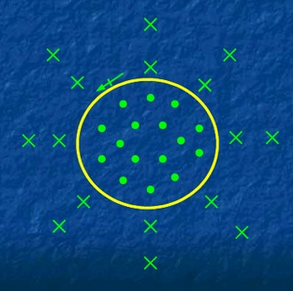
Arrow is the direction of the current; x's are the magnetic  fields coming into the page; dots are the magnetic field coming out of the page
As shown in the picture, the field inside the loop is stronger than the field outside of the loop. Also, the field is more uniformed inside the loop

Magnetism: Natural Magnetism

Important Terms:
Ferromagnetic: adjective used to describe metals that are highly magnetic (such as iron, cobalt, and nickel)
Domain: a small region within a magnetic material which has uniform magnetization
Magnetic Field: region of space that will exert a force on a moving charge or magnetic field that enters the space
Field Density: how strong a magnet's magnetic field is


Important Theory/Concepts
Domain Theory: Permanent magnets are are ferromagnetic metals that have all of their domains aligned. On the other hand, non-magnetic ferromagnetic materials' domains are not aligned in any way.


Strength of magnetic forces: The force of attraction or repulsion between two permanent magnets is inversely proportional to the distance between the two.

Non-Permanent Magnets: when a permanent magnet is brought near a non-magnetized piece of ferromagnetic material, the former will temporarily align the domains in the latter, thus magnetizing latter. However, once the former is removed, the domains in the latter will removed back to being random.

Magnetic Field: each magnet has a magnetic field, which can be represented by lines of force. The more lines of force that a magnet has, the stronger it is. The arrows in the diagram represent the directions of the force that an object will experience if it is placed on a particular point in the diagram. Also, all lines of force exit from the north pole and enters the south pole.


Miscellaneous
  • the domains of a magnet become misaligned if the magnet is dropped or hit
  • when a permanent magnet is heated above the Curie point (different for each material), it'll lose its magnetic properties
  • magnetic fields tend to be strongest at the two poles of the magnet